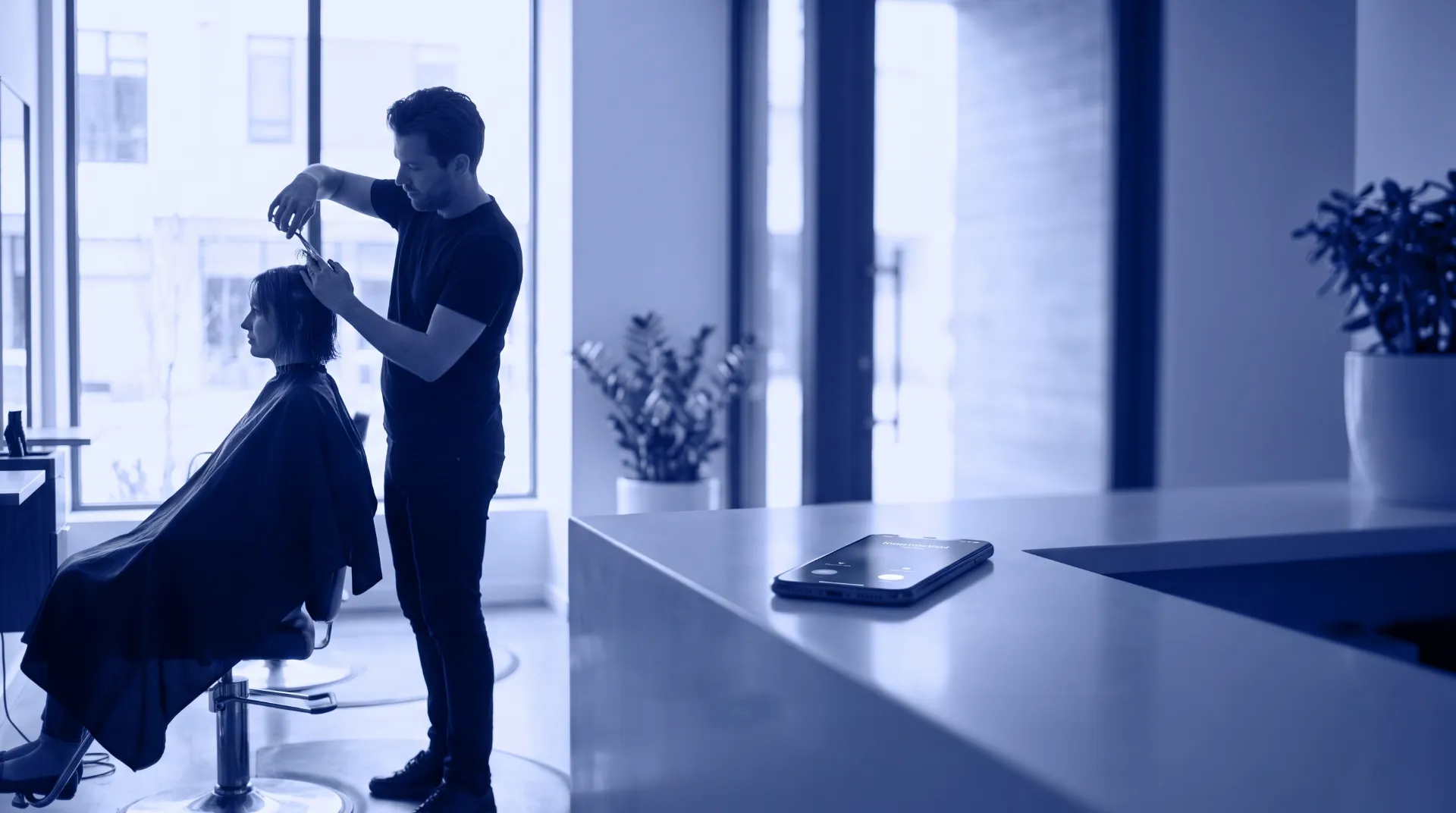
The greeting is the moment callers decide whether to stay on the line or hang up. This guide gives you the three parts every greeting needs, the right length, notes on voice and tone, six example scripts for a salon, a practice, a workshop, a driving school, a vet and a tattoo studio, the usual mistakes and a test with three real calls.
Why the first sentence decides the call
Whoever calls you expects a person. If a voice answers instead and does not say who it is or what it can do, many callers hang up before the assistant has had a chance to listen. So the first sentence has to answer three questions at once: Am I in the right place? Who am I talking to? What can I get done here?
A caller who gets those three answers in the first few seconds usually stays. They know they have reached the right business, that they are talking to an assistant, and that their request will be handled. Everything else, the voice, the tone, the examples, builds on that first sentence.
AI phone assistant greeting script: the three parts
A good greeting is made of a name, honesty and an offer. The name comes first, because otherwise callers cannot tell whether they have dialled the wrong number. Honesty follows immediately: this is an assistant, not a person. The offer closes and says what the caller can do now, for example book an appointment or ask a question.
The whole greeting stays under ten seconds. That is roughly two short sentences. Anything longer sounds like a queue message, and callers start talking before the assistant has finished. Read your script aloud once with a stopwatch and you will know whether it fits.
- Name: "This is Salon Marlene" goes right at the front, even before the hello.
- Honesty: "You are speaking to the digital assistant", with no euphemisms.
- Offer: "I can book, move and cancel appointments and answer questions."
- Question: "What can I help with?" as the cue to start talking.
Voice and tone: formal or casual, warm or businesslike?
The assistant speaks the way you speak to customers at the counter. If your shop is on first-name terms with everyone, the assistant can be too. If you are more formal, so is it. A tattoo studio sounds different from a dental practice, and the greeting is allowed to show that. It only has to match what customers then experience in person.
A little regional warmth helps. A local greeting word makes the script sound more human without pretending there is a human. Do not overdo it: one word is enough, the rest stays in clear standard language so that callers with an accent understand everything.
With terminio.ai you set the greeting, the voice and the moment the assistant picks up in the app under Phone. You choose between several voices, for example warm and calm or male and serious, and hear how your script sounds in a test call.
What the assistant must answer, and what it hands over
The greeting makes a promise, and the rest of the call has to keep it. Callers ask five things almost every time: opening hours, prices, directions and parking, a new appointment, and moving an existing one. You store those answers in advance. Whatever is not stored, the assistant should not guess, but say honestly that it does not know.
Just as important is the list of what it does not take on. Emergencies, complaints and anything medical or legal belong with a person. The assistant has to recognise those and hand over cleanly. A good hand-over sentence names the reason and the next step: "That is not something I can settle on the phone. I will take your number and Ms Berger will call you back today."
- Answer: opening hours, prices or a price range, directions, parking, payment.
- Handle: book, move and cancel appointments, put a request on the waiting list.
- Hand over: emergencies, with one clear number to call instead.
- Hand over: complaints, medical and legal questions, always with a call-back.
Virtual receptionist greeting examples: six scripts
The following scripts stick to the three parts and stay under ten seconds. Use them as templates and swap in your name, your form of address and your offer. The practice script also works as a plain voicemail greeting if you run without an assistant and only want to offer a call-back.
- Salon: "Hi, you have reached Salon Marlene, this is the digital assistant. I would be happy to book your appointment. What can I do for you?"
- Practice: "Dr Berger's practice, good morning. You are speaking to the appointment assistant. In an emergency, please hang up and call 112."
- Workshop: "Kaya Auto Repair, hello. I am the assistant and I book appointments for servicing, tyres and repairs. What do you need?"
- Driving school: "North Driving School, good afternoon. This is the digital assistant. I can answer questions about signing up and book your lessons."
- Vet: "Park Veterinary Practice, hello. You are speaking to the assistant. Emergencies I pass on straight away. How can I help?"
- Tattoo studio: "Hey, this is Studio Nordlicht. I am the studio's assistant. Consultation or a question? Go ahead."
The most common greeting mistakes
The worst mistake is pretending to be human. Callers notice by the second sentence at the latest, and then the trust is gone, not just in the assistant but in your business. An assistant is allowed to sound friendly and natural. It just must not claim to be Lisa from the team.
The second mistake is the menu. "Press 1 for appointments" was annoying back on the old answering machine. A voice assistant does not need keys, it understands the question. The third mistake is the dead end: a caller who cannot find a way to a person does not call again.
- Pretending: no greeting that presents itself as a member of staff.
- Menus: no key presses, no list of options to choose from.
- Dead ends: always offer a call-back or a transfer.
- Advertising: no promotions or offers before the caller's request.
- Length: cut anything that runs past the ten-second mark.
Three test calls before the assistant goes live
Before you switch on call forwarding, call the assistant yourself, three times with three different requests. Bring in someone who has not heard the script yet, a family member or a regular customer. Their reaction in the first few seconds tells you more than any amount of thinking at the desk.
After the three calls, change whatever snagged and call again. Then go live, ideally at first only for the calls nobody picks up. That way you hear a week of real conversations before the assistant also answers during the day.
- Call one: book an appointment for next week, with a preferred time.
- Call two: ask for a price and directions, then hang up.
- Call three: a request it has to hand over, for example a complaint.